What Cyber Insurance Actually Looks For
Insurers have paid out billions in claims over the past several years — ransomware attacks, data breaches, business email compromise —and they've gotten very serious about who they cover and what they require. If you're a small business owner who either has cyber insurance or is thinking about getting it, here's what you need to know.
Modern cyber insurance applications look more like security audits than insurance forms. They ask specific, technical questions — and the answers affect not just you’re premium but whether you get coverage at all. Mis-entering the wrong information on the application (even unintentionally) can result in a denied claim when you need it most.
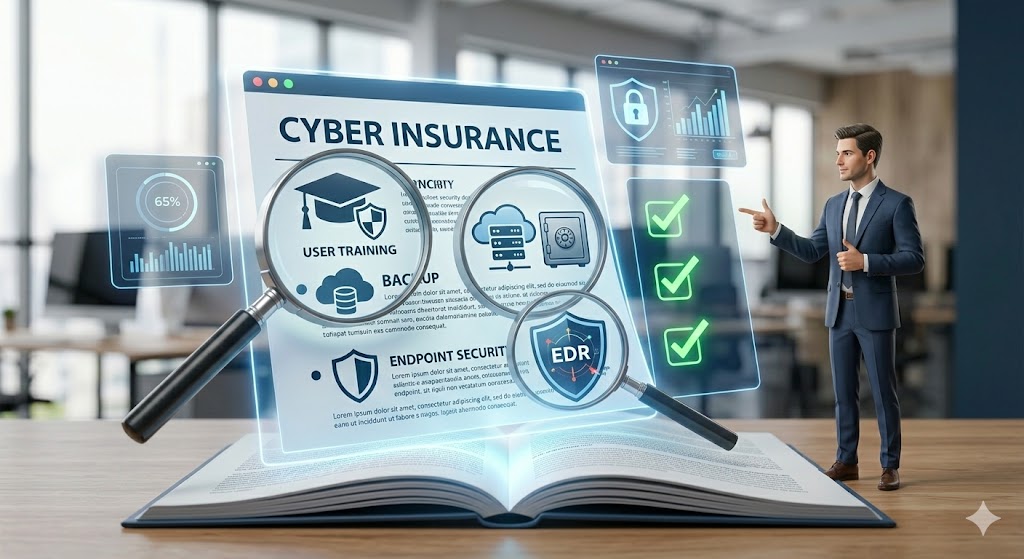
• Multi-factor authentication (MFA). This is now a near-universal requirement. Many insurers will flatly decline coverage or exclude certain claims if MFA isn't in place on email, remote access, and financial systems.
• Endpoint detection and response (EDR). Basic antivirus isn't enough anymore. Insurers want to see active monitoring tools that detect threats in real time —not just scan for known viruses.
• Backups that are tested and offline. Having backups is one thing. Having backups that are regularly tested, stored separately from your main systems, and can'tbe encrypted by ransomware is what insurers want. Cloud sync is not a backup.
• Patch management. Are your systems up to date? Unpatched software is one of themost common entry points for attackers — and insurers know it. They want evidence that you apply security updates consistently.
• Employee security training. Phishing is still the number one-way attackers get in. Insurers want to know whether your staff knows how to recognize suspicious emails. Annual training is increasingly a baseline expectation.
• Privileged access controls. Not everyone in your organization needs access toeverything. Insurers want to see that admin-level access is limited and monitored.
After an incident, insurers will investigate. They'll look at your systems, your logs, and your security practices. If they find that you answered the application questions inaccurately — or that you had controls inplace on paper but not in practice — they have legal grounds to reduce or deny your payout.
This is especially important for medical offices and dentalpractices that handle protected health information. A breach in those environments can trigger HIPAA penalties on top of the direct costs of the incident — and if cyber insurance doesn't pay out, the financial exposure canbe severe.
Think of your cyber insurance application as a security roadmap. If you can't honestly check the boxes, those are exactly the gaps youshould prioritize closing. The good news is that most of what insurers require— MFA, backups, basic training, patching — isn't expensive. It's mostly amatter of making it a consistent practice.
A policy you can collect on is worth far more than a cheaper policy that gives you a false sense of security.
Complex networks and relentless threats call for smarter, integrated security, beyond the basics.

Have questions or want a demo? Fill out the form below and we’ll respond promptly.